⚡ Key Takeaways
- AI in website development has shifted from experimental to essential, with agencies reporting up to 40% faster delivery times using automated web development workflows.
- The role of AI in web development is transforming developers from syntax writers into system architects and reviewers.
- Generative AI in web design and AI coding assistants are now baseline requirements, not optional add-ons.
- Bespoke AI-integrated solutions vastly outperform off-the-shelf builders for complex, scalable enterprise needs.
In 2026, AI in website development is no longer just about writing code faster; it is about fundamentally restructuring how digital agencies operate, deliver value, and scale custom solutions. Agencies leveraging AI-powered web development are seeing 30–50% improvements in project turnaround times while maintaining high-quality standards through automated QA and intelligent code generation.
The future of web development agencies is being rewritten in real-time. Just a few years ago, integrating AI into a client's website meant adding a basic chatbot. Today, in 2026, artificial intelligence is the engine driving the entire development lifecycle — from initial UI/UX prototyping to backend architecture, automated testing, and deployment.
For agency owners, CTOs, and project managers, the question is no longer if you should adopt these tools, but how you can restructure your operations to leverage AI in website development before your competitors do. This guide breaks down exactly how AI is reshaping agency workflows, the new skills your team needs, and how to manage client expectations in an era of instant digital solutions.
The Shift in Agency Workflows
The most immediate impact of using AI in web development is the dramatic acceleration of agency workflows. Historically, the bottleneck in web development was the sheer volume of repetitive coding, debugging, and QA testing required to bring a design to life.
Today, automated web development workflows have eliminated much of this friction. AI coding assistants for agencies — such as GitHub Copilot, Cursor, and proprietary LLM-driven IDEs — can now generate boilerplate code, write complex regex functions, and translate design files directly into clean, responsive frontend frameworks in seconds.
Accelerated Delivery and Quality Assurance
Agencies that have fully integrated these tools report a 30% to 50% reduction in initial development time. However, speed is only half the equation. AI is also revolutionizing Quality Assurance. Automated testing agents can now crawl newly deployed environments, identify broken UI elements, check for accessibility (WCAG) compliance, and even suggest code fixes before a human reviewer ever looks at the pull request.
By offloading the repetitive execution to AI, agencies can reallocate their billable hours toward high-level strategy, complex backend integrations, and client communication — areas where human insight remains irreplaceable. Our own custom web development practice has adopted this model with measurable results for every client engagement.
The New Role of the Developer
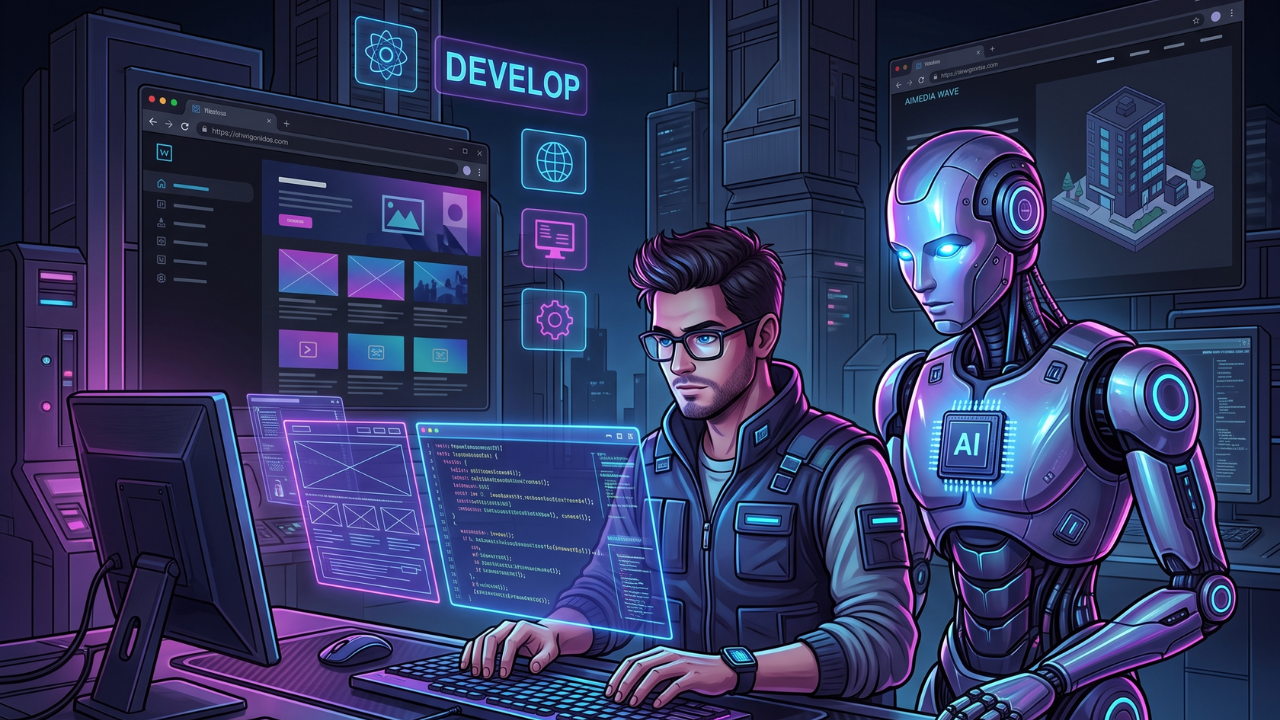
With AI handling the heavy lifting of syntax generation, the role of AI in web development is forcing a paradigm shift in what it means to be a developer. We are witnessing the transition from "code writers" to "digital architects."
From Typing to Architecting
In 2026, a developer's primary value lies in their ability to design scalable system architectures, understand complex business logic, and securely integrate third-party APIs. The AI writes the function; the developer ensures the function solves the right business problem securely and efficiently.
Prompt Engineering for Web Developers
A critical new skill in the agency toolkit is prompt engineering for web developers. Writing effective prompts to guide LLMs requires a deep understanding of coding principles, context management, and edge-case anticipation. Developers must know how to feed an AI the exact constraints, tech stack parameters, and security protocols needed to generate production-ready code. This skill is now as important as knowing a programming language itself.
AI in Design & Frontend
The intersection of design and code has never been blurrier. Generative AI in web design is allowing agencies to move from static mockups to dynamic, interactive prototypes almost instantly.
UI/UX Automation and Component Generation
Tools powered by AI-powered web development models can now analyze a brand's design system and automatically generate fully coded, responsive UI components that adhere strictly to the client's guidelines. If a client requests a new pricing table, the AI can generate the Figma design and the corresponding React/Tailwind code simultaneously.
This capability drastically reduces the "design-to-dev" handoff friction. Frontend developers spend less time translating pixel-perfect designs into CSS and more time optimizing the component for performance, interactivity, and dynamic data fetching — exactly what our web development team does today.
Managing Client Expectations
As AI tools become mainstream, agency teams are facing a new objection from prospects: "If AI can build a website in five minutes, why are we paying your agency for a three-week build?"
Navigating the debate of AI website builders vs. custom development is now a core part of the agency sales process.
The Limits of Off-the-Shelf AI Builders vs. Custom AI Advantage
AI website builders (like Wix AI, Framer AI, or Squarespace AI) are excellent for simple, brochure-style sites. However, they operate within rigid, templated ecosystems. They cannot:
- Build custom, proprietary backend logic or complex database relationships.
- Seamlessly integrate with a client's legacy enterprise software (ERP, CRM).
- Guarantee enterprise-grade security, data privacy compliance, or custom AI agent integrations.
- Scale infinitely without being locked into the platform's ecosystem and pricing tiers.
When pitching AI-based web development, agencies must emphasize that true value lies in custom AI integration, not just AI-generated templates. A custom-built, AI-enhanced web application is tailored to the client's exact operational workflows, offering proprietary features, superior performance, and complete data ownership.
2026 Trends & Future Outlook
Looking ahead, the web development trends 2026 point toward a future where AI agents operate semi-autonomously within the development lifecycle.
Agentic Workflows
We are moving beyond simple copilots to "agentic workflows." In this model, a developer assigns a high-level task (e.g., "Build a user authentication flow with OAuth and set up the database schema"), and an AI agent plans the steps, writes the code, runs the tests, and fixes its own errors — only asking the human developer for approval at critical checkpoints. According to the Stack Overflow Developer Survey 2025, over 76% of developers are now using or planning to use AI tools in their development process.
Hyper-Personalization and the Future of Web Design
Websites are increasingly using edge-AI to dynamically alter the UI, content, and user journey in real-time based on individual visitor behavior, demographics, and intent — without requiring a page reload. Agencies that master these dynamic, AI-driven frontend experiences will command a premium in the market.
Traditional Development vs. AI-Assisted Development: A 2026 Comparison
| Feature | Traditional Web Development | AI-Assisted Development (2026) |
|---|---|---|
| Coding Speed | Manual syntax writing; slower iteration | AI generates boilerplate and complex functions instantly |
| QA & Testing | Manual testing; prone to human oversight | Automated AI agents run continuous edge-case testing |
| Design-to-Code | Manual translation of Figma to CSS/React | Direct AI translation of UI components to responsive code |
| Developer Focus | 80% writing code, 20% architecture/strategy | 20% reviewing AI code, 80% architecture/strategy |
| Scalability | Linear scaling (requires more developers) | Exponential scaling (AI handles repetitive workload) |
| Best For | Legacy systems, highly restricted environments | Modern web apps, rapid prototyping, complex integrations |
Conclusion & CTA
The integration of AI in website development is the most significant shift the digital agency industry has seen since the advent of responsive design. Agencies that embrace AI-based web development will deliver faster, build smarter, and offer higher-value strategic partnerships to their clients. Those that resist will find themselves outpaced by leaner, AI-native competitors.
Ready to Transform Your Digital Presence?
At Ai Media Wave, we don't just build websites — we engineer intelligent digital ecosystems. From AI-powered web applications to next-generation GEO strategies, our AI-first team is ready to future-proof your business.