The future of SEO is no longer just about pleasing web crawlers; it is about convincing Large Language Models (LLMs) that your brand is the most authoritative answer to a user's problem. At Ai Media Wave, we have observed a massive shift in how search engines retrieve and synthesize information. If you are still relying solely on legacy tactics, you are already falling behind.
⚡ Key Takeaways
- The future of SEO is Generative Engine Optimization (GEO), where entity authority matters more than exact-match keywords.
- Generative search engine platforms use LLMs to synthesize answers, leading to a massive rise in zero-click searches.
- Traditional SEO focuses on ranking for clicks; GEO focuses on being cited as the source of truth by AI.
- AI will not replace SEO professionals, but it will shift the role from manual optimization to AI content optimization and strategy.
What is the future of search engine optimization? The future of SEO is Generative Engine Optimization (GEO). Unlike traditional SEO, which optimizes for keyword rankings and click-through rates, GEO optimizes content to be cited by Large Language Models (LLMs) and AI search engines. It prioritizes entity authority, structured data, and direct, quotable answers over keyword density.
The Rise of the Generative Search Engine
To understand where search is going, we must understand the underlying technology. A generative search engine does not just return a list of blue links; it reads, understands, and synthesizes information from multiple sources to generate a direct answer.
Large Language Models (LLMs) in search rely on complex AI-driven search algorithms that map relationships between entities (people, places, concepts) rather than just matching text strings. When a user types a query, the LLM retrieves relevant data from its index, cross-references it for factual accuracy, and generates a unique, synthesized response. This is precisely why our SEO & digital marketing services now integrate GEO as a core strategy.
The Impact on Traffic and Zero-Click Searches
The integration of SEO and AI-generated content has fundamentally altered user behavior. With AI Overviews and chat interfaces providing instant answers, traditional Click-Through Rates (CTR) for informational queries are dropping significantly.
Zero-click searches now account for a majority of informational queries. According to SparkToro's research on zero-click search trends, the share of clicks going to external sites continues to decline. While this sounds alarming, it presents a massive opportunity: if your content is chosen as the source for an AI Overview, your brand gains massive top-of-funnel visibility and authority, even if the immediate click is lost.
Generative Engine Optimization (GEO): The New Rulebook
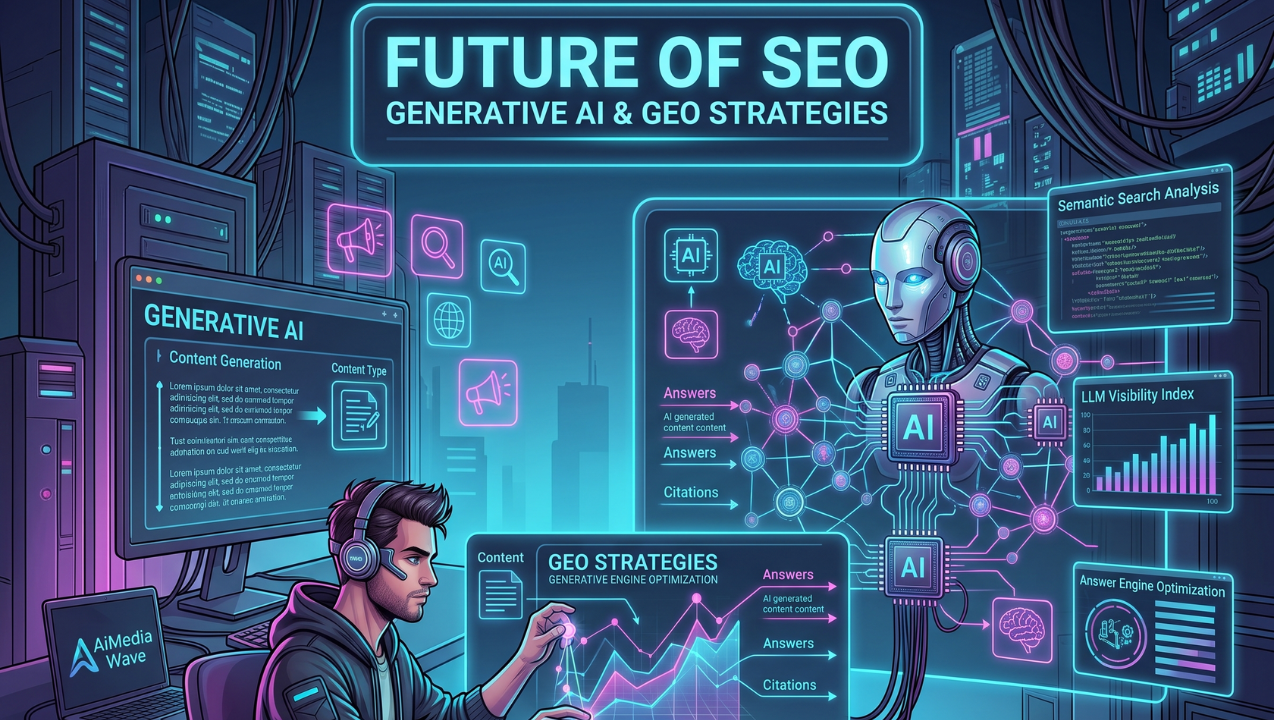
Generative Engine Optimization (GEO) is the practice of optimizing digital content to be cited and recommended by AI search engines and LLMs. While traditional SEO focuses on ranking for specific keywords to drive clicks, GEO focuses on building entity authority, providing structured data, and writing highly quotable, factual content that AI models can easily parse and trust.
The shift from keyword-based algorithms to AI-driven search algorithms requires a fundamental change in how we build content. We are moving toward a unified approach where semantic understanding is king, and where structured answers win over keyword density.
Traditional SEO vs. GEO: A 2026 Comparison
| Feature | Traditional SEO | Generative Engine Optimization (GEO) |
|---|---|---|
| Primary Goal | Rank on Page 1 for specific keywords | Be cited as the source in AI-generated answers |
| Content Format | Long-form, keyword-optimized articles | Structured, quotable, direct answers with clear entities |
| User Interaction | Drives clicks to the website | Often zero-click, but builds brand authority and citations |
| Technical Focus | Backlinks, page speed, meta tags | Schema markup, entity graphs, structured data, citations |
| Query Type | Short-tail and exact-match keywords | Conversational search queries and complex natural language |
Entity-Based SEO vs. Keyword SEO
To win in this new era, your content must be easily parsable by machines. This means moving away from repeating exact-match keywords and instead building "entity authority." You must clearly define who and what you are, how your concepts relate to others, and structure your data so an LLM can extract the exact fact it needs without guessing.
Optimizing for conversational search queries means structuring your H2s and H3s as natural language questions and providing direct, comprehensive answers immediately below them — exactly the structure that Google's Search Central documentation on AI Overviews recommends for maximum visibility.
Actionable AI and SEO Strategies for 2026
Adapting to this shift doesn't mean throwing away your old strategy; it means layering AI content optimization on top of a strong technical foundation. Here is our step-by-step playbook:
- Structure Data for Machines: Implement robust Schema markup (JSON-LD) for articles, FAQs, and organizations. AI models rely heavily on structured data to understand context.
- Build Entity Authority: Stop writing just for keywords. Write to establish your brand as a definitive entity in your niche. Get mentioned on authoritative third-party sites to build your knowledge graph.
- Create "Quotable" Content: Include 40–60 word direct definitions and standalone factual statements. AI models look for concise, authoritative sentences to cite in their overviews.
- Optimize for Conversational Queries: Rewrite your headers to match natural language prompts. Answer the "Who, What, Where, When, and How" explicitly.
- Audit for AI Citations: Regularly check AI platforms like Perplexity, ChatGPT Search, and Google AI Overviews to see which competitors are being cited, and reverse-engineer their content structure.
Our SEO and GEO services implement all five of these pillars for every client, including building entity graphs and FAQPage schema that get directly ingested by LLMs.
What Are the Best AI Search Engines in 2026?
To optimize for AI, you must understand where your users are searching. Here are the top AI search engine examples dominating the market:
- Perplexity AI: Best for deep research, real-time web browsing, and highly cited academic/professional answers.
- ChatGPT Search (GPT-4o): Best for conversational, multi-step queries and personalized recommendations.
- Google AI Overviews: The most critical for traditional businesses, as it integrates directly into the world's most used search engine.
- Microsoft Copilot: Best for enterprise users and deep integration with the Microsoft ecosystem.
Will AI Replace SEO? The Evolving Role
Will AI replace SEO professionals? No, but it will fundamentally change the role. The days of manual meta-tag tweaking and keyword stuffing are over. SEO professionals are evolving into "Search Experience Architects." Instead of just optimizing for a crawler, you are now optimizing for a conversational AI. Using AI in SEO means leveraging AI tools to research, outline, and analyze data faster, allowing humans to focus on high-level strategy, brand storytelling, and complex entity mapping.
Ready to Dominate the Future of Search?
At Ai Media Wave, we specialize in bridging the gap between traditional search and the AI era. From advanced GEO to AI-driven content strategies, we help you become the authoritative source that both Google and AI models trust.